Whole-Home Surge Protection and East Texas Storms: Is It Worth It?
Lightning is only one of the ways a surge reaches your house, and a power strip alone does not cover all of them.
October 13, 2026 · 4 min read
A summer thunderstorm rolls through. The lights blink once, maybe twice, and come back. Nothing seems wrong. A few days later the air conditioner will not start, or the TV has a dead port, or the router that never gave you trouble is suddenly gone. You might never connect it to that storm, but the storm is often the reason.
Our FAQ answers the question of whether whole-home surge protection is worth it with a plain yes: electrical surges can harm electronics, appliances, HVAC equipment and smart home devices. Here is the reasoning behind that answer, what the system does, and where its limits are, so you can decide for your own place.
What a surge is
Your home is supplied with electricity at a steady voltage. A surge is a short spike above that level. It might last only a fraction of a second, but electronics are built around that steady voltage, and a spike that exceeds what they are designed to handle can damage them immediately or wear them down a little at a time.
Where surges come from
Most people think of lightning, and lightning is a real cause. A strike on or near a power line, a tree or the ground nearby can push a surge onto the wiring. But it is not the only one. Surges can also come from:
- Utility fluctuations, such as when the power company switches equipment, a line trips and resets, or power is restored after an outage
- Storm damage, like a downed line or a tree limb across the wires
- Large motors cycling on and off, including the ones inside your own home, like the air conditioner compressor, a well pump or a shop compressor
- Equipment problems on the supply side, which you have no way to see or control
That last point matters if you live out in the country. Rural properties are often served by long overhead lines that run through open land and trees, which gives storms and fluctuations plenty of ways to reach you.
The damage you can see and the damage you cannot
Some surge damage is obvious. A device is fried, a board is burned or something simply will not turn on. Other damage is quieter. Smaller surges can stress the components in electronics and appliances a little each time, so a device that has taken many small hits may fail sooner than it otherwise would, with no clear cause.
What whole-home surge protection does
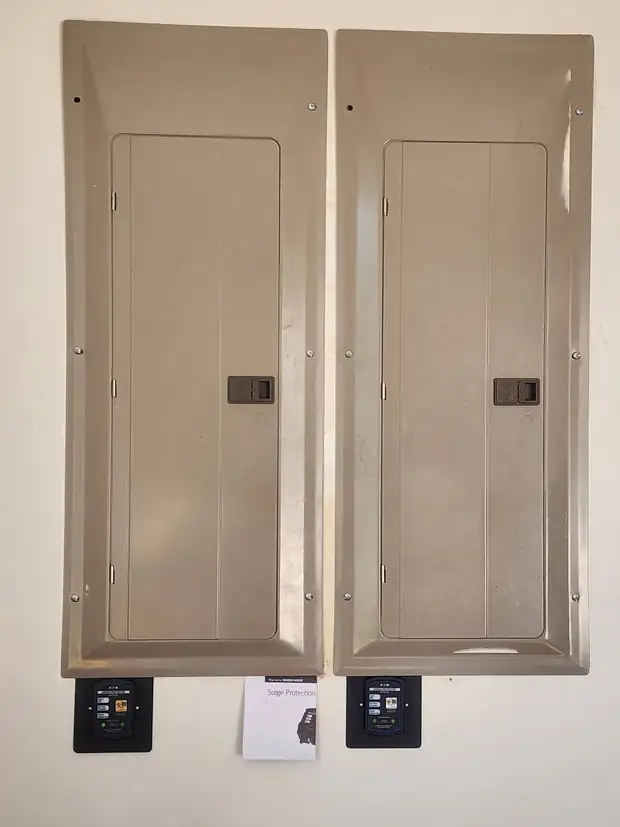
A whole-home surge protection system is installed at your electrical panel, where power enters the house. Its job is to catch surges at the front door and divert the excess energy away before it travels through your wiring to everything you own. It protects the circuits in your home as a group, including the ones that plug-in strips can never cover, such as the air conditioner, the water heater, the well pump, the oven and lighting circuits.
That is the difference from a power strip. A plug-in surge strip protects only what is plugged into it. It is a perfectly good last layer for sensitive electronics like computers and televisions. But it does nothing for the hardwired equipment in your house. The two work best as layers: protection at the panel, and point-of-use protection for the electronics you care about most.
Why the install matters
A surge protector is only as good as how it is installed. It needs to be connected correctly at the panel, and it depends on good grounding to give the surge somewhere safe to go. If the grounding in an older home is poor or missing, a protection device cannot do its job well. That is one reason this is electrician work and not a project to wing. Most systems also have a status indicator, which shows whether the protection is still active. A protector that has absorbed enough surges can reach the end of its life, and the indicator tells you when that has happened.
Is it worth it for you?
A fair way to think about it is to look at what a surge could damage. Add up what is in your house: the air conditioning or heat system, the well pump if you have one, the refrigerator, the washer and dryer, the TVs, the computers, the router, and any smart home devices. Then consider how often storms and outages hit your area, and how long a replacement would take. If you have a good deal of equipment, a well or HVAC system that you would hate to replace, or work-from-home gear, the case for protection is strong. That matches our FAQ answer.
It is also worth being honest about limits. Whole-home surge protection reduces the risk from surges, but it does not make a house immune to everything, and a very large event can still overwhelm any system. Unplugging truly valuable equipment during a severe storm is still a smart habit, and so is keeping an eye on the status indicator.
Our Surge Protection service installs whole-home systems that guard against lightning strikes and utility fluctuations for homes in Athens and the surrounding towns. Justin Zimmerman, the owner and a master electrician, does the install himself, and the labor carries a five-year warranty. Call (903) 218-3632 and we can look at your panel and talk through what makes sense for your property.
GO 2 Electrical Service LLC, (903) 218-3632
Call (903) 218-3632More articles
Why Your Breaker Keeps Tripping (and Why Resetting It Again Is the Wrong Fix)
A breaker that trips once is doing its job, and one that trips repeatedly is telling you to find out why.
Standby Generators for Homes Outside Town: What Goes Into a Safe Install
A standby generator is only as good as the planning behind it, and most of that planning happens before the machine ever arrives.